Last week, the United States executive branch attempted to unilaterally deny Harvard the ability to enroll international students, and further threatened the legal status of countless students if they did not transfer from the ivy league titan. Political condemnation immediately followed, with U.S. Representative Jamie Raskin (D-MD) declaring the policy an “intolerable attack on Harvard’s independence and academic freedom.”
This is an admirable though typical response to the administration’s latest offensive on diversity policies and non-U.S. residents. Although I did not disagree with the sentiment, I was struck by the wording. Where does this idea of Harvard’s independence come from? And what is the extent of this independence? A closer inspection of the Trump-Harvard showdown reveals how powerful institutions challenge our traditional understanding of sovereignty.
For a primer on sovereignty, I can think of no better and more influential account than the one offered by Thomas Hobbes in his Leviathan. To escape the dreaded war of all against all in the state of nature, Hobbes emphasizes the importance that a sovereign’s power is absolute once the social contract is formed. This means that sovereign decisions are final, regardless of any protests by the subjects. This is the case even today: the law binds, and disagreement is no excuse. To change the law, sovereign power must be exercised, such as an act by legislature or court.
In line with this absolute power, Hobbes emphasizes that the sovereign’s power cannot be forfeited and it cannot be divided. The unified power of the sovereign is the glue that keeps the multitude from being in a state of war. Conflicting orders from two equally legitimate sovereigns threaten to “reduce the Multitude into the condition of Warre” once again.1
Hobbes’ conception of sovereignty has echoes in the past, such as Machiavelli’s advice that “nothing can be so uncertain or unstable as fame or power not founded on its own strength.”2 Implicit from such an exclusive and absolute authority is the premise that the sovereign must be independent. A sovereign whose power depends on another necessarily does not have absolute power, because the other could obstruct and limit the sovereign’s authority.
The influence of Hobbes also continues to endure. Max Weber keeps in mind sovereign exclusivity when he defines the state as a “human community that (successfully) claims the monopoly of the legitimate use of physical force within a given territory.”3 That a sovereign maintains ultimate authority within its territory is the fundamental principle that underlies the Westphalian system—a principle that largely persists despite significant changes in the international order. And even though the Westphalian system is frequently deemed a Eurocentric model, China and Russia have become its primary proponents while Europe turns towards transnational liberalism. In short, Hobbes’ sovereignty is not only that of a monarchy: it is sovereignty as it has widely been understood from autocracies to democracies, from liberal states to socialist states.
Let’s return to Representative Raskin’s condemnation of the executive action. There are two parts of this critique, and each has different underlying premises: that Harvard’s independence is being threatened, and second, that its academic freedom is being threatened.
Let’s begin with the easier claim. Academic freedom can be traced to a truly sovereign source: the U.S. Constitution’s First Amendment. The Constitution grants Congress a broad and plenary power under Article I; nevertheless, it “shall make no law … abridging the freedom of speech” under the First Amendment. It’s significant that these conditions are found within the social contract itself. Recall that sovereignty is the highest and absolute form of authority. For the government to be limited at all, it must come from its own authority, otherwise it would not be supreme. In short, only government can limit government. Thus, the First Amendment—a constitutive element of the Constitution—is an internal limitation on sovereignty.
The second claim is that Harvard’s “independence” is being threatened. Perhaps this is merely a synonym for “academic freedom” discussed earlier, which would make the statement redundant. That’s plausible, since the quote is an off-hand media statement, not a speech or a treatise. But I suspect that there is a different, broader sense to this “independence.”
First, the obvious. Harvard is a private institution, and the U.S. has a deep tradition of private property that is robustly protected from interference by the state (see, e.g., the Fifth Amendment Due Process and Takings Clauses). Thus, Harvard is independent to the extent that the government does not infringe on their traditional private property rights under law. But here, the issue is not simply a traditional property interest, such as the ability to admit any students whatsoever. Instead, Harvard’s interests implicate the United States’ sovereign power to control its internal affairs such as migration, inter-state travel, and possibly naturalization. Foreign residents are given a status to remain by law, not by the grace of private institutions. It would be a plain infringement on U.S. sovereignty for Harvard to declare independence from application of certain laws or public powers. Indeed, it is a public policy (the Student and Exchange Visitor Program) which grants Harvard the ability to admit foreign students.
While it is plausible the revocation of this certification is unlawful (through a breach of procedure or otherwise), it is not clear that the government is wholly without authority. I find the government’s actions appalling here on many levels, but claiming Harvard is independent from sovereign power tout court is untenable. The key question is whether the administration has followed the procedure and limits of its power, not whether Harvard enjoys independence from the laws.
More likely, the Representatives’ appeal to Harvard’s independence reflects the value that institutions of learning ought to be independent from the sovereign, or from political winds generally. This is not a new idea; in fact, it reflects a long-standing tension between the political world and the world of contemplation.
Early monastic tradition valued asceticism and rejected the urbanity of the city. Early Christians had a general attitude of contemptus mundi, or contempt for worldly things, as their lives were to be dedicated to the heavenly and eternal. Augustine writes in City of God that the earthly city is “often divided against itself by litigations, wars, quarrels,” and all its possessed goods will be destroyed in time, whereas the heavenly city enjoys everlasting peace and eternal goods.4 In this same vein, monasteries could serve as communities where Christians could retreat from city life and its earthly affairs and dedicate themselves to spiritual practice.
Reality was more complicated. Just as cities throughout the Roman Empire were patronized by elites, so too were monasteries.5 The monasteries welcomed the resources and the increased profile of Christianity, and elites enjoyed expanding their network of wealth and prestige. Perhaps most importantly for our purposes, elite families would gain access to literary culture and education.6 Monasteries would also slowly become enmeshed with the political and legal world. In the seventh century, monasteries successfully petitioned for tax exemptions for imported goods.7 These circumstances made the line between earthly and heavenly pursuits muddier.
Monasteries and similar religious institutions were the forerunners of the university system we have today. Even as universities turned to secular topics of learning, they valued a degree of independence from the political forces in the world. In 1158, Emperor Frederick Barbarossa signed the Privilegium Scholasticum, a document which granted traveling scholars certain immunities from local laws. The emperor intended that the “professors of divine and sacred laws” should receive imperial protection and expressed sympathy to those who “exile themselves through love of learning.”8 Despite the wording, the document was intended to protect both theological and secular study, such as Roman law, which was enjoying a revival at the time. In fact, Roman law in the third and fourth centuries had granted exemptions from public service to those who were giving others a liberal arts education. Note, however, that in both cases they are privileges conferred by a sovereign to the educators. In other words, it is the sovereign internally limiting the domain of its power, not an external force.
There are many differences between the universities of today and the monasteries of yore. Still, one can imagine a throughline: the institutions value objects of contemplation in themselves, be they secular or religious. Both believe that true knowledge transcends politics itself. Of course, there are also practical reasons to favor academic independence. Political considerations could severely diminish the quality of education and research, and moreover, make it susceptible to overt political manipulation. So from a normative and descriptive point of view, it seems independence truly is essential to noble pursuits of knowledge.
At the same time, we can imagine necessary limits to this independence. Take, for instance, race or sex-based discrimination in higher learning. Currently, the government can only regulate institutions that receive public funding, or else it runs afoul of the First Amendment. This is an awkward limitation that frustrates aims at universal equality. Furthermore, educational independence from the state seems contradictory with a more robust system of universal public education. How can the state be both responsible for guaranteeing a basic level of education, and yet not have an intervening influence? Thus, liberal democracies are often in this irreconcilable position where they want the state to finance education, but distrust the state at the same time. Worst of all is the fact that neither attitude is completely unreasonable. This is the dilemma lurking beneath the Harvard vs. Trump stand-off.
The independence I’ve been talking about is not merely historical or theoretical—it is material in every sense of the word. Harvard boasts a $54 billion dollar endowment. What’s more, Harvard alumni can be found everywhere in the halls of power. It should be unsurprising to learn that Representative Raskin, quoted above, holds a degree from the venerated institution. These degree holders in turn hope to pass on the privilege to their children, and so on. It’s not just a matter of pride for them; it’s a matter of generational wealth and prestige. These are not merely popular images projected by Harvard. The shadow of their colossal presence is familiar to everyone, everywhere.
It goes without saying that Harvard is uniquely positioned to resist a government—a superpower, no less. And when the university does so, progressives will celebrate. Naturally enough: folding like a cheap suit would be bad, and wholesale embrace of the administration would be even worse. But there is a cynical opportunity for Harvard as well. There are few things that could be a Goliath to them. The leviathan state is precisely that rare thing which can give Harvard the halo of heroism that only an underdog can get. At a time when elites are reviled and inequality is widening, cultural cachet will pay dividends towards legitimating the university.
Harvard is a conservative university. It reflects in their faculty, their curriculum, and even their choice of legal counsel. While universities are sometimes hotbeds of progressivism and even radicalism, media perception tends to mistake a puddle for the ocean. These vocal sects of the student body are the youngest and the most financially indebted—in short, the least powerful. So, while the university wages war against the administration, it does it on its own terms. Harvard will claim a high-minded path just as the early Christian monasteries did. And like them, it will inevitably entangle itself in the political process and use its own leverage.
Unlike a Constitutional right or a co-equal branch of government, a university such as Harvard poses an external threat to sovereignty. Despite being within a sovereign’s own borders, the university is outside of the states exclusive sphere of influence and wields its own. It has its own resources which it can draw from as it vies for power in the political arena. Unlike a government, Harvard lacks the public facing accountability that each state must reckon with, electorally or otherwise. Harvard is indeed independent—from the state and the masses alike.
Universities are not the only independent institutions that act as external limits on sovereignty. When the Trump administration attempted to levy tariffs on the entire world just a few months ago, investors immediately sent market signals spelling out total collapse. The value of American assets plummeted worldwide, and multinational corporations fled with their capital as far as they could. The Trump administration could not sustain such heavy losses to their resources and credibility. So the government immediately scaled back the policy, retreating from its hardline stance. The President could not have the final say in trade policy even if he wanted to; he would need Wall Street’s approval first.
If an institution can tank a sovereign’s prerogative, how much power is exclusively the sovereign’s? The answer is impossible to quantify, but it’s almost certainly less than 100%. The ideal Hobbesian “sovereign” does not and cannot exist, because any state depends on obedience from a critical mass of its subjects. In an equal world, this critical mass would be the majority of the populace. In an unequal world, the critical mass is where the money is.
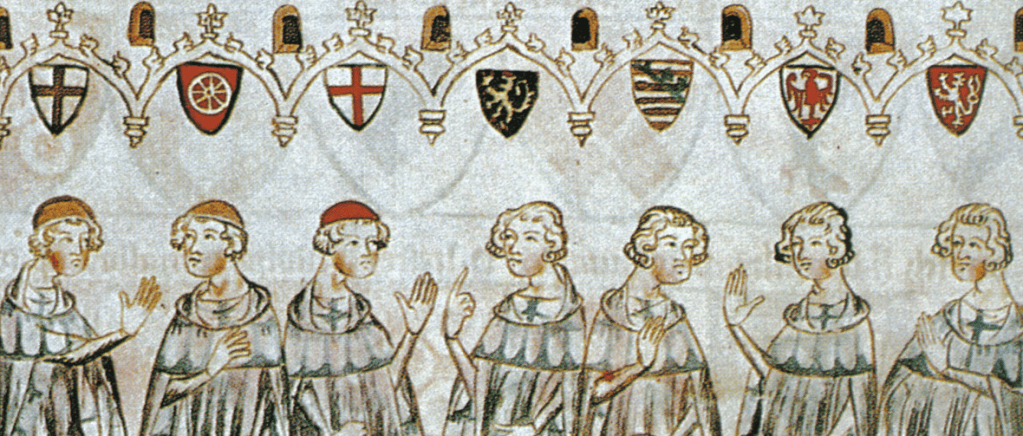
I imagine the great American institutions of today as being akin to the German princes of the Holy Roman Empire. The princes’ strength was localized, while the emperor theoretically had universal dominion and command of an imperial army. The princes, too, enjoyed liberties which the emperor was loath to recognize. The princes collectively provided the infrastructure and resources which the emperor relied upon throughout his domain. In her account of the Thirty Years’ War, C.V. Wedgwood describes the imperial dynamic accordingly:
“[Emperor] Ferdinand knew the limit of his power. It stretched as far and no farther than his armed force could carry it, and for that armed force he still depended on the Catholic League and Maximilian of Bavaria. The Protestant delegates at Regensburg had expressed their disapproval by refusing any further grants of money for the war; they might be too weak to resist, but they were not quite so simple as to subsidize an attack on their liberties.”
C.V. Wedgwood, The Thirty Years’ War (1938), p. 159
The German princes had opposing religions, interests, and no doubt some dishonest motives. Nevertheless, they could act together to check the whims of the emperor. At times, this served peace. But remember that princes only seek peace insofar as it favors them and their little dominions.
The Thirty Years’ War ended with the Treaty of Westphalia, which brought forth the model of sovereignty we have come to accept. But true sovereignty remains an elusive ideal for any state. One may welcome these contradictions today as they check a dangerous and unruly administration. But as we envision a new political future, we must not forget that even the most noble lawbringer must eventually reckon with a revolt of princes.
***
“Don’t let it bring you down
It’s only castles burning
Just find someone who’s turning
And you will come around”
Neil Young, “Don’t Let It Bring You Down”
1. Hobbes, Leviathan, Ch. 19
2. Machiavelli, The Prince, Ch. 13
3. Weber, Politics as Vocation (1918) (emphasis added)
4. Augustine, City of God, Book 15. Ch. 4
5. Fafinski & Riemenschneider, Monasticism and the City in Late Antiquity and the Early Middle Ages, p. 12-14
6. Id. at 16.
7. Id. at 22.
8. Kibre, Scholarly Privileges in the Middle Ages (1962), p. 18


Leave a Reply